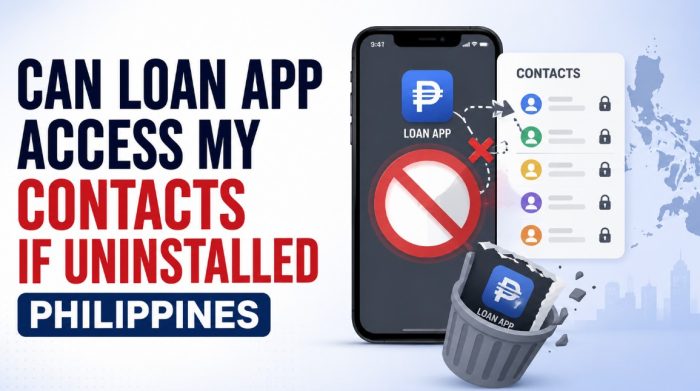
No — once you uninstall a loan app, it can no longer actively access your contacts in real time.
But here’s the part most people don’t know: the damage may have already been done before you uninstalled it.
Many predatory lending apps in the Philippines harvest your entire contact list, call logs, and even SMS data the moment you grant permissions during installation — and that data is stored on their servers, not just on your phone.
Uninstalling the app removes it from your device.
It does not delete the data they already copied.
This is the uncomfortable truth that thousands of Filipino borrowers have had to learn the hard way.
What Happens To Your Contacts When You Install A Lending App
Most people tap “Allow” without reading what permissions they’re granting.
Here’s what a typical loan app asks for when you install it on your Android phone:
- Access to Contacts
- Access to Call Logs
- Access to SMS
- Access to Camera and Microphone
- Access to Device Storage
- Access to Location
Some of these are genuinely needed for identity verification.
Most of them are not.
When you grant contacts permission, the app can read every name and number in your phonebook — and in many cases, it uploads that list to a remote server immediately.
That upload happens in the background, silently, often within the first few seconds of opening the app.
By the time you fill out your loan application, your 300-plus contacts may already be sitting in a database somewhere overseas.
Can A Loan App Still Access My Contacts After I Uninstall It
Let’s be very direct about this.
After uninstalling, the app itself loses all access to your phone.
Android and iOS both enforce this — once an app is removed, it cannot run in the background, cannot send data from your device, and cannot read your current contacts list.
So in a technical sense: no, the app cannot actively access your contacts after uninstallation.
But here’s what can still happen:
The contacts they already harvested are still on their servers.
They can still use that list to send messages to your contacts — because they don’t need your phone to do it.
They have the numbers.
They can send texts, make calls, or have their collection agents manually dial those contacts using the list they copied earlier.
This is exactly what happened to a borrower I know from Pampanga — we’ll call him Kuya Rey.
He borrowed ₱5,000 from an app called (let’s say) “QuickPeso” sometime in 2026.
Two weeks after he uninstalled the app and stopped responding to collectors, messages started arriving at his mother’s number, his cousin’s workplace, and his former supervisor’s Facebook Messenger.
The app was gone from his phone.
But they already had the numbers.
What Data Loan Apps Typically Harvest Before You Even Know It
Here is a breakdown of what unauthorized data collection by predatory lending apps typically involves:
| Data Type | When It’s Collected | Risk After Uninstall |
|---|---|---|
| Contacts list | At first app launch | Contacts can still be messaged by collectors |
| Call logs | During active use | Can be used to identify close relationships |
| SMS content | Some apps read SMS silently | Private messages may be accessed and stored |
| Location history | During app use | Can be used to verify employment/address |
| Device ID (IMEI) | At installation | Used to block re-registration |
| Photos/Gallery | If storage permission granted | Profile photos sometimes used to shame borrowers |
The most dangerous combination is contacts + call logs — because it tells collectors not just who you know, but who you talk to most.
That’s how they know to call your mother at 6 AM.
The Data Privacy Act And What It Means For You
Under Republic Act 10173 — the Data Privacy Act of the Philippines — any company that collects your personal data must:
- Inform you clearly about what data is being collected
- Get your specific, informed consent for each type of data
- Use the data only for the purpose it was collected for
- Delete the data when it is no longer needed
When a lending app uploads your contacts to use for debt collection harassment — that is a violation of this law.
When they continue using that data after you’ve ended the loan relationship — that is also a violation.
The National Privacy Commission (NPC) has the authority to fine companies up to ₱5 million and recommend criminal charges for serious violations.
You can file a complaint at privacy.gov.ph.
How To Minimize The Damage If You Already Installed A Suspicious Loan App
If you realize you’ve already installed a suspicious lending app that had access to your contacts, here’s what you can do right now:
Step 1: Revoke permissions before uninstalling.
Go to your phone’s Settings → Apps → [App Name] → Permissions.
Revoke access to Contacts, SMS, Call Logs, Camera, and Storage.
Do this before uninstalling — it’s a small extra step but forces the app to disconnect any background sync.
Step 2: Uninstall the app immediately.
Once permissions are revoked, remove the app from your device.
Step 3: Inform your closest contacts.
Send a simple message to your most important contacts — family, employer, close friends — letting them know they might receive suspicious calls or texts related to a loan app.
Tell them to ignore and block.
Step 4: Document everything.
Screenshot any harassing messages you or your contacts receive.
Note the dates, times, and exact content.
This is your evidence for any formal complaint.
Step 5: File a complaint with the NPC and SEC.
The Securities and Exchange Commission (SEC) handles complaints against unregistered or abusive lending companies.
The NPC handles data privacy violations.
Both can be filed online.
How To Check If A Loan App Is Registered With The SEC
Before installing any loan app, verify it on the SEC’s official list.
Go to sec.gov.ph and look for the list of registered Lending Companies and Financing Companies.
If the app you’re considering isn’t there — do not install it.
Unregistered lending operations have no legal obligation to follow collection rules, and they face almost no consequences when they abuse borrowers.
They exist specifically to take advantage of people who need money fast and don’t check the fine print.
To learn more about spotting these operations before they cause damage, this guide on recognizing suspicious and fake lending apps in the Philippines covers the red flags in detail.
What Android Permissions Actually Mean And What To Watch For
When you install an app on Android, these permission requests should raise immediate concern for a simple loan app:
| Permission Requested | Legitimate Use | Red Flag If… |
|---|---|---|
| READ_CONTACTS | None needed for loans | Asked at first open before any form |
| READ_CALL_LOG | None needed for loans | Always a red flag |
| READ_SMS | OTP verification only | Asks during sign-up, not just OTP |
| RECORD_AUDIO | None needed for loans | Any request is suspicious |
| READ_EXTERNAL_STORAGE | Profile photo upload | Asks for full storage access |
| ACCESS_FINE_LOCATION | Branch finder (maybe) | Required before any other action |
A legitimate digital lender regulated by the BSP or SEC does not need your call logs.
It does not need to read your SMS inbox beyond receiving OTP codes.
It does not need your entire photo gallery.
If an app requests these permissions and won’t work without them — that is your signal to close it and uninstall immediately, even before you complete registration.
A Note On iOS vs Android: The Difference Matters
iPhone users in the Philippines have an advantage here.
iOS limits background data access much more aggressively than Android.
On iOS, an app cannot access your contacts without you seeing a clear permission pop-up, and it cannot run in the background after you close it without explicit permission.
Most predatory lending apps in the Philippines specifically target Android users because the permissions system has historically been easier to exploit.
If you’re on Android, the permission screen at installation is your first and most important line of defense.
Read it.
Take it seriously.
Real Consequences: What Happens When Collectors Have Your Contacts
The harassment pattern that follows unauthorized contact harvesting is well-documented across Filipino borrower communities.
It usually follows this sequence:
Day 1–3 of missed payment: The borrower receives calls and texts directly.
Day 3–7: Messages begin arriving at contacts — usually framed as “concern” for the borrower.
Day 7–14: The tone shifts to public shaming — messages sent to multiple contacts simultaneously accusing the borrower of being a “scammer” or “fraud.”
Day 14+: In some cases, posts appear on Facebook groups or localized community pages.
Every single step after the first is illegal under Philippine law.
The Lending Company Regulation Act and SEC Memorandum Circular No. 18, Series of 2019 explicitly prohibit contacting third parties other than the borrower’s designated references.
They prohibit using abusive or threatening language.
And they prohibit public disclosure of a borrower’s debt.
If any of this has happened to you or someone you know, understanding what to watch out for in loan app charges and terms can also help you understand the full picture of how these apps operate.
What You Cannot Do — And What Actually Works
A lot of borrowers try things that don’t help.
Factory resetting your phone does not delete data that’s already on their servers.
Changing your SIM card doesn’t stop them from texting your contacts — they already have the numbers.
Blocking their numbers helps, but they often use rotating numbers.
Ignoring it completely sometimes works but only if you have no significant debt and they assess it’s not worth pursuing.
What actually works:
Filing with the NPC creates a legal obligation for the company to respond and justify their data handling.
Filing with the SEC can trigger license suspension or revocation.
Filing with the PNP Anti-Cybercrime Group creates a criminal record of the harassment that can support further action.
For a broader understanding of your rights as a borrower and consumer in the Philippines, the financial consumer rights resources at this site cover the topic in a way that’s grounded in the actual Philippine regulatory framework.
Frequently Asked Questions
Can a loan app access my contacts if I haven’t given it permission?
On a standard Android phone, no — it needs permission to access contacts.
But many apps use deceptive UI design to make you grant permission without realizing it, or bundle the contact permission into a general “allow all” screen.
Always check your installed app permissions manually.
If I clear the app cache, does it delete the data they collected?
No.
Clearing cache removes temporary files on your device.
It has no effect on data already uploaded to their servers.
Can I demand they delete my data?
Yes.
Under the Data Privacy Act, you have the right to erasure — you can request a company to delete your personal data.
Send a written request to their registered address or email.
If they don’t comply within a reasonable time, that non-compliance becomes part of your NPC complaint.
How do I know if my contacts were already accessed?
Practically speaking, you may not know until contacts start receiving messages.
But you can check your phone’s data usage history (Settings → Network → Data Usage) and look for unusual spikes from the app during its first few minutes of use — that’s often when harvesting occurs.
What if the app already disappeared from the Google Play Store?
This is extremely common.
Apps get removed by Google but the company often reappears under a different name.
The SEC pursues companies, not app listings — so having the company name from your loan agreement is more important than the app name.
Is this only a problem with small or unknown apps?
No.
Even some apps that appear professional and well-designed have been found to engage in unauthorized data collection.
The size and appearance of the app is not a reliable indicator of whether it respects your data rights.
The SEC list is the only reliable check.
Huwag magtiwala sa star ratings sa Play Store — maraming fake reviews din doon.
The Bottom Line
Once a loan app is uninstalled, it cannot reach into your phone to access new contacts.
But if it already harvested your contacts before you uninstalled it — and many do this within seconds of installation — that data remains with them.
They can and do use it.
The most important protection is before you install: check the SEC list, read the permissions carefully, and if the app asks for contacts and call logs upfront with no clear reason — walk away.
If the damage is already done, document, report, and take legal action.
The system is imperfect and slow — but it does work, especially when enough borrowers file formal complaints.

Để lại một bình luận