A fake loan app can be identified by several clear warning signs: no SEC registration number, requests for upfront fees before loan release, access to your contacts and photos beyond what’s necessary, and no verifiable physical address or customer support.
If you’re reading this because you just downloaded an app that felt “off” — trust that instinct.
Fake online lending apps in the Philippines have become more sophisticated every year, and in 2026, they’re harder to spot than ever because many of them now copy the branding, color schemes, and even app names of legitimate lenders.
This guide will walk you through exactly how to tell a real app from a scam — based on real cases, SEC advisories, and firsthand experience reviewing dozens of loan apps.
The First Thing To Check: SEC Registration
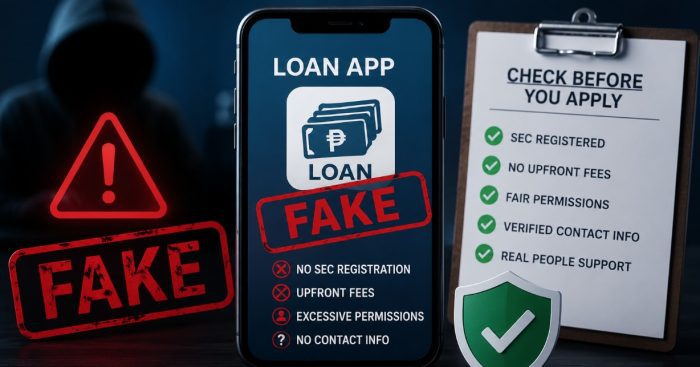
Every legitimate online lending platform operating in the Philippines must be registered with the Securities and Exchange Commission (SEC) and must hold a Certificate of Authority (CA) to operate as a lending company.
This is non-negotiable under Republic Act 9474, also known as the Lending Company Regulation Act.
If an app cannot show you a valid SEC registration number, stop the application immediately.
Here’s how to verify:
Step 1: Go to the official SEC website at www.sec.gov.ph.
Step 2: Click on the “Online Lending Platforms” section or use the company search tool.
Step 3: Type in the name of the app or company.
Step 4: Check if their Certificate of Authority is active — not expired, not revoked.
Step 5: Cross-check the registration number shown in the app with the one in the SEC database.
A legitimate app will not hesitate to show you this number upfront, usually in the “About” section or in their terms and conditions.
Warning Signs Of A Fake Loan App In Philippines
| Red Flag | What It Looks Like | What It Means |
|---|---|---|
| No SEC registration | App shows no CA number or it doesn’t match SEC records | Operating illegally |
| Upfront fee required | Asked to pay ₱200–₱1,000 before loan is released | Classic advance-fee scam |
| Unrealistic approval | “Guaranteed approval in 5 minutes, no requirements” | Too good to be true |
| Excessive permissions | Requests full contact list, gallery, call logs | Data harvesting for harassment |
| No physical address | No office address listed anywhere | Untraceable operation |
| Copied branding | Logo and name look similar to a known legitimate app | Impersonation scam |
| Pressure tactics | “Apply NOW or lose this offer” | Manipulation to skip due diligence |
| No customer support | Only a chatbot or no contact channel at all | No accountability |
If an app triggers even two of these, do not proceed.
The Upfront Fee Trap: Most Common Fake App Scam
The single most reported scam tactic in the Philippines involves asking borrowers to pay a fee — often labeled as “processing fee,” “insurance fee,” or “activation fee” — before the loan is released.
This is always a scam.
Legitimate lending companies deduct any processing fee from the loan amount after it’s approved — they never ask you to send money first.
Here’s how it usually plays out:
The app approves your loan almost instantly.
Then a “customer service agent” contacts you via SMS or Facebook Messenger.
They tell you the loan cannot be released until you pay a small “tax clearance” or “insurance activation” fee of ₱300 to ₱1,500.
Once you pay, they disappear — or ask for more fees.
This pattern has been documented in hundreds of complaints filed with the SEC, BSP, and the Philippine National Police Anti-Cybercrime Group (PNP-ACG).
Real Case: A Borrower From Bulacan
A jeepney driver from Bulacan I’ll call Kuya Romy applied for a ₱10,000 loan through an app he found on Facebook.
The app had a polished interface and showed logos that looked similar to a known legitimate app.
He received an “approval” within two minutes.
Then a message came: “Pay ₱800 insurance fee to activate your loan.”
He paid.
Then came another message: “We need a ₱1,500 deposit for verification purposes.”
He paid again — this time borrowing from a neighbor.
After the second payment, the account went silent.
The app disappeared from the Play Store within the week.
He lost ₱2,300, never received a single peso of the “loan.”
This is not an unusual story — it’s the standard playbook of fraudulent loan applications in the Philippines.
How Fake Loan Apps Steal Your Data
Beyond stealing money directly, fake mobile lending apps often collect your personal data to use as leverage.
They do this through excessive app permissions.
When you install the app, it asks for access to:
Your full contact list.
Your SMS messages.
Your phone gallery and camera.
Your call logs.
Your location history.
A legitimate loan app needs your name, income details, a photo of your ID, and perhaps your GPS location for address verification.
It does not need access to your photos or your entire contact list.
Data harvesting through fake apps has led to widespread debt shaming in the Philippines — where scammers or even legitimate-but-abusive lenders contact a borrower’s family, friends, and colleagues to demand repayment, often sharing embarrassing or fabricated information.
The SEC has issued multiple advisories and cease-and-desist orders against apps engaging in this practice, but fake apps operating outside the law simply ignore those orders and disappear before enforcement catches up.
Understanding data privacy risks in online lending can help you know exactly which permissions are acceptable and which are exploitation.
How To Check If A Loan App Is Real Or Fake: Step-By-Step
Step 1: Search the app name + “SEC registration Philippines” before installing.
Step 2: Install the app but do NOT grant any permissions yet — just browse the “About” and “Terms” sections first.
Step 3: Look for a physical office address and working customer support number.
Step 4: Call or email that customer support number before applying — a fake app usually has no real support.
Step 5: Check the app’s Google Play Store or Apple App Store reviews — look for complaints about no loan release or demands for upfront fees.
Step 6: Verify the developer name on the app store — if it’s a random string of characters or doesn’t match the company name, it’s suspicious.
Step 7: Search the company name on the SEC ESAS portal (https://esas.sec.gov.ph) to confirm active CA status.
Step 8: If everything checks out, read the full loan terms before submitting any personal information.
Fake Loan App Vs. Legitimate Loan App: Side-By-Side
| Feature | Fake Loan App | Legitimate Loan App |
|---|---|---|
| SEC Certificate of Authority | None or fake number | Valid, verifiable on SEC website |
| Upfront fees | Required before loan release | Never — fees deducted from loan |
| Approval time | Seconds, no verification | Minutes to hours with ID verification |
| App permissions | Excessive (contacts, photos, SMS) | Minimal and relevant only |
| Customer support | Unavailable or unresponsive | Real email, phone, or chat support |
| Physical office | None listed | Registered address verifiable |
| Interest rate disclosure | Vague or hidden | Clear before you apply |
| Repayment terms | Unclear or changes after approval | Written in app, no surprises |
What To Do If You’ve Already Used A Fake Loan App
If you’ve already submitted your personal information or paid a fee, act immediately.
Step 1: Stop all contact with the app or its “agents.”
Step 2: File a complaint with the SEC at [email protected] with screenshots of the app, conversations, and payment receipts.
Step 3: Report to the PNP Anti-Cybercrime Group at camp.pnpacg.ph or call their hotline.
Step 4: Alert your bank or e-wallet provider (GCash, Maya) to flag the transaction.
Step 5: If the app has your contact list, notify your close contacts that they may be harassed on your behalf.
Step 6: Change passwords on any accounts that may be linked to your phone number.
The faster you report, the better the chance of preventing further damage — both to you and to others who might fall into the same trap.
How To Find Safe And Legitimate Loan Apps Instead
The best protection against fake apps is knowing how to find real ones in the first place.
A detailed guide on choosing a safe loan app in the Philippines covers the exact criteria — SEC registration, transparent fee structures, fair interest rate policies, and borrower rights — that separate trustworthy digital lending platforms from predatory ones.
You can also browse a curated list of SEC-registered and reviewed lending apps at dienbiencflit to start your comparison from a verified source rather than a random Facebook ad.
Frequently Asked Questions
How do I know if a loan app is registered with the SEC in the Philippines?
Go to the SEC website at www.sec.gov.ph or the ESAS portal at esas.sec.gov.ph.
Search for the company name or their stated registration number.
A valid Certificate of Authority (CA) must appear and must not be revoked or expired.
Can a fake loan app steal money from my bank account?
Not directly — but if you granted the app access to your device and your banking app is on the same phone, there is a risk of credential harvesting through malicious software embedded in the app.
Always download apps only from official app stores and avoid sideloading APKs from unknown sources.
Is it safe to apply for loans through Facebook ads?
No, not without verifying first.
Many scam lending apps are promoted through Facebook and Instagram ads specifically because the barrier to running an ad is low.
Always verify the SEC registration independently before clicking anything in a Facebook loan advertisement.
What if the loan app has thousands of positive reviews on Google Play?
Fake reviews are purchasable and common.
A more reliable signal is the ratio of 1-star reviews that mention specific issues like “no loan released” or “asked for fees.”
Also check the date of those reviews — a sudden spike in 5-star reviews over a short period is a known manipulation pattern.
Does the government have a hotline for reporting fake loan apps?
Yes.
You can report to the SEC at (02) 8818-6337 or email [email protected].
You can also file a cybercrime complaint with the PNP-ACG at (02) 8723-0401 or via their official website.
The Bangko Sentral ng Pilipinas (BSP) also accepts complaints at (02) 8708-7087 if the lender is a BSP-supervised entity.

Để lại một bình luận