Loan apps in the Philippines typically hide charges through upfront processing fees deducted from your loan principal, service fees buried in fine print, escalating penalty charges for late payments, and rollover fees that silently increase your total debt.
These are not always labeled clearly before you tap “Confirm.”
Many Filipinos apply for ₱5,000 but receive only ₱3,800 in their GCash — and only realize later that the difference was quietly taken as fees before disbursement.
That’s the real problem this article will break down for you.
What Are Hidden Charges In Loan Apps And Why Do They Matter
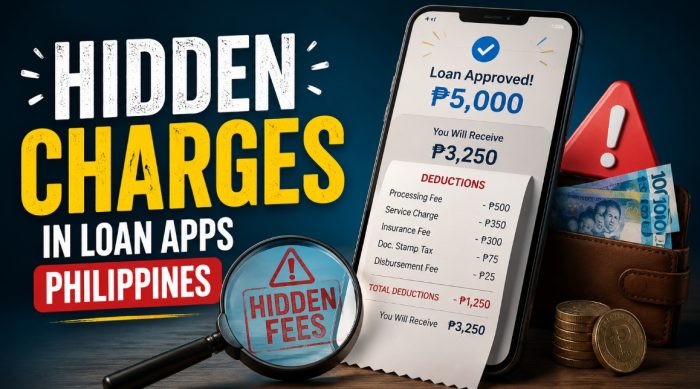
The phrase hidden charges in loan apps does not always mean the lender is doing something completely illegal.
Sometimes it means the charges were disclosed — but buried three screens deep in a terms-and-conditions page written in dense legal English that most borrowers skip.
The result is the same: you borrow ₱10,000 and only ₱7,500 lands in your bank account.
According to the Truth in Lending Act (Republic Act No. 3765), every lender in the Philippines is legally required to disclose the full cost of borrowing before the loan contract is signed.
Section 4 of that law specifically requires that finance charges — covering interest, fees, and any other costs — must be clearly stated upfront.
So when an app deducts a ₱500 “verification fee” without explaining it before you clicked accept, that is not just a surprise — it may be a legal violation.
The Securities and Exchange Commission (SEC) has been increasingly aggressive about this.
In August 2025, the SEC issued cease-and-desist orders against seven unregistered online lending platforms — including Peso101-Fast Loans PH, Peso Cow-Mabilis Pera Loan, and Swiftloan — for violating SEC Memorandum Circular No. 19, Series of 2019, which mandates full disclosure of loan terms.
Those apps were shut down not just for operating illegally — but specifically for hiding what borrowers would actually pay.
The 7 Most Common Hidden Charges In Loan Apps Philippines
Understanding each type of fee is the first step to protecting yourself.
Here is a breakdown of what to watch for, how each one works, and how lenders disguise them.
1. Processing Fees Deducted From The Loan Principal
This is the most common trick.
You apply for ₱5,000 and the app approves you.
But when the money arrives in your account, it is ₱4,200 — because ₱800 was taken as a processing fee before disbursement.
Philippine law requires lenders to disclose the gross loan amount, deductions, actual amount received, interest, fees, total payable amount, and due date before the borrower agrees to the loan.
The dangerous part is that you still repay the full ₱5,000 — even though you only received ₱4,200.
That gap is effective interest you never acknowledged.
Hidden “service” or “processing” fees deducted upfront that exceed 15% of the loan amount are flagged by legal experts as a red flag for predatory lending under Philippine law.
2. Service Fees And Platform Fees
Different names, same trap.
Some apps call it a “platform fee.”
Others label it a “membership fee” or “disbursement fee.”
A borrower may apply for a stated loan amount but receive significantly less because of “processing fees,” “service fees,” “platform fees,” “disbursement fees,” “membership fees,” or “verification fees” that were not clearly disclosed before acceptance.
When you see multiple fee types listed together without a clear total, that is a sign the lender does not want you to calculate the actual cost.
3. Late Payment Penalties That Compound Daily
Missing a payment by even one day can trigger fees that grow every 24 hours.
Penalty fees and late charges in many Philippine loan apps are excessive — sometimes accruing daily — and can inflate the debt rapidly, trapping borrowers in a cycle they cannot escape.
A ₱100 daily penalty on a ₱3,000 loan sounds small.
But after 30 days of struggling to pay, that is ₱3,000 in penalties on top of the original debt — effectively doubling what you owe.
4. Rollover Fees And Loan Extension Charges
When you cannot pay on time, some apps offer to “extend” your loan.
This sounds helpful — but the extension comes with its own fee.
And that fee is often added to a new principal, which then accrues new interest.
This is how borrowers get stuck in debt traps that spiral out of control.
One borrower in the Philippines eventually accumulated ₱200,000 in debt after borrowing from multiple loan apps — each offering to help manage the previous debt, but adding new charges along the way.
5. Insurance Premiums You Never Asked For
Some apps automatically add a “loan protection insurance” charge to every loan.
You did not opt in.
It is just there in the final repayment amount.
Hidden fees in predatory loan apps include origination fees hidden in the disbursed amount, late fees that escalate daily, service fees, and “insurance” premiums that were never made optional.
The insurance rarely provides meaningful coverage — it mainly increases the lender’s revenue per loan.
6. Prepayment Penalties
Trying to pay off your loan early to save on interest?
Some apps penalize you for that too.
Prepayment penalties — fees charged for paying off a loan early — discourage borrowers from escaping the debt cycle, which is a hallmark of predatory lending in the Philippines.
This is the lender protecting their interest income at your expense.
7. Add-On Interest Calculated On Original Principal
This one is less visible but extremely costly.
Legitimate lenders calculate interest on your declining balance — the amount you still owe goes down as you make payments, and so does the interest.
Add-on interest computation — where interest is charged on the original principal rather than the declining balance — is one of the most common predatory practices found in Philippine online loan apps.
The difference between these two methods can mean thousands of pesos more in interest over a 12-month loan.
Comparison Table: Legitimate vs. Predatory Loan App Charges
| Charge Type | Legitimate Practice | Predatory Practice |
|---|---|---|
| Processing Fee | Disclosed upfront, deducted clearly | Hidden until disbursement |
| Interest Rate | Stated as monthly & annual (APR) | Shown as daily rate only |
| Late Penalty | Fixed amount, clearly stated | Compounding daily, no cap |
| Insurance | Optional, clearly explained | Auto-added without consent |
| Rollover Fee | Disclosed before extension | Added silently to new loan |
| Early Repayment | No penalty or minimal | High fee to discourage payoff |
| Total Cost | Shown before you accept | Only visible after confirmation |
Real Story: How A ₱5,000 Loan Became A ₱12,000 Debt
A call center employee from Quezon City — I’ll call her Mylene — borrowed ₱5,000 from a popular loan app she found on Facebook in early 2024.
The app advertised “0% interest, fast approval.”
She approved the loan without reading the full terms because the approval timer was counting down from 10 minutes.
What she received: ₱3,900.
What she was told to repay: ₱5,000 in 14 days.
She could not pay on time and extended the loan — for a ₱400 fee.
Two extensions later, her outstanding balance was ₱7,200.
She borrowed from another app to pay it off.
Three months later, she owed ₱12,400 across three different loan apps — none of which had clearly disclosed their total charges when she first applied.
This is not an unusual story.
It is the debt trap cycle that Philippine consumer advocates have been warning about for years.
Why Loan Apps Can Get Away With This In The Philippines
The Philippines has good laws protecting borrowers — but enforcement gaps exist.
The SEC has issued licences for 140 digital lending companies in the Philippines, but fewer than 40 of those licences have been revoked for unfair practices — suggesting a significant number of problematic lenders remain active.
Being listed on the Google Play Store does not mean a loan app is legitimate — many scam apps have passed store review using AI-generated descriptions and fake reviews.
This means borrowers cannot rely on app store placement as proof of safety.
The apps also move fast — they register under new names, get a fresh Play Store listing, and target new borrowers before regulators catch up.
What Philippine Law Says About Hidden Fees
Three laws protect Filipino borrowers specifically from predatory loan charges:
Republic Act No. 3765 – Truth in Lending Act
Requires full disclosure of all finance charges before loan consummation.
The Truth in Lending Act explicitly prohibits lenders from concealing or misrepresenting loan costs — Section 4 requires that finance charges must be clearly disclosed to the borrower before the transaction is completed, ensuring borrowers are aware of the total cost of credit.
SEC Memorandum Circular No. 19, Series of 2019
Requires online lending platforms to disclose all fees, penalties, and the total amount the borrower will actually receive — before the loan is released.
Republic Act No. 11765 – Financial Products and Services Consumer Protection Act
This law allows the SEC to sanction financial service providers that fail to comply with consumer protection standards — including those that hide loan charges from borrowers.
Failure to disclose all processing fees, penalties, service charges, deductions, and the total amount received by the borrower constitutes a deceptive lending practice, which can lead to administrative sanctions, suspension, or revocation of a company’s license.
If you find that an app violated any of these, you have grounds to file a formal complaint.
How To Calculate If You’re Being Overcharged
Before you accept any loan, do this quick math:
Step 1: Note the loan amount you applied for (e.g., ₱5,000).
Step 2: Note the actual amount that will land in your account (e.g., ₱3,900).
Step 3: The difference (₱1,100) is already a cost — before interest even applies.
Step 4: Divide that deduction by your loan amount: ₱1,100 ÷ ₱5,000 = 22%.
Step 5: If your loan term is only 14 days, your effective annual rate on that fee alone is already over 500%.
The formula for Effective Interest Rate is: EIR = (Total Finance Charges ÷ Loan Amount) × (365 ÷ Loan Term in Days) × 100.
Use this formula every time — not just the rate advertised on the app’s front screen.
How To Protect Yourself From Hidden Loan App Charges
The goal here is not to scare you away from borrowing — sometimes you genuinely need fast cash.
The goal is to make sure you borrow from lenders who respect your right to know the full cost.
Here is what to do before approving any loan:
Verify SEC registration first.
Go to sec.gov.ph and search the lender’s name — not the app name, but the company name listed in the app’s “About” section.
If you want a deeper guide on spotting fake or unregistered lending platforms, check out this resource on how to identify fraudulent loan apps before you download anything.
Read the loan summary screen — not just the home screen.
Legitimate apps show a clear breakdown: amount applied, deductions, amount to receive, interest, total repayable, and due date — all before you confirm.
If you have to click “Accept” before seeing a full breakdown, that is a red flag.
Screenshot everything before you tap confirm.
If charges change between the approval screen and disbursement, you have evidence for a complaint.
Calculate your EIR before accepting.
Use the formula above.
If the effective annual cost exceeds 100%, think very carefully before proceeding.
For a broader guide on what separates safe lenders from predatory ones, choosing a reliable loan app in the Philippines covers the full checklist with SEC verification steps.
Red Flags That Signal Hidden Charges Are Coming
Watch for these patterns — they appear across dozens of reported predatory apps:
The countdown timer.
“Your loan offer expires in 8 minutes!”
This pressure tactic prevents you from reading the terms carefully.
Legitimate lenders do not rush you into a signature.
“0% interest” promotions.
While the first loan may be advertised as “0% interest,” most apps re-price subsequent loans at 48–72% APR — always check all fees beyond the interest rate label.
Vague fee names.
If the app lists “administrative fee,” “convenience charge,” and “document processing fee” separately without explaining each one — that is deliberate obscurity.
No physical business address.
Loan apps with no physical address, foreign-based operations, or reviews complaining of surprise charges are consistently identified as suspect by Philippine legal experts.
No clear breakdown before you confirm.
If an app hides fees until the last page — or forces you to click through multiple screens to see charges — it is not compliant with Philippine lending regulations and is almost always unsafe.
What To Do If You’ve Already Been Hit With Hidden Charges
First: do not panic, and do not borrow from another app to pay it off.
Second: document everything.
Take screenshots of your loan agreement, the amount you received, your repayment schedule, and any messages from the app.
Third: file a complaint with the SEC.
The Truth in Lending Act imposes penalties including fines up to ₱100,000 and imprisonment from six months to one year for lenders who fail to comply with disclosure requirements.
You can file via the SEC’s official website or visit their offices in Mandaluyong.
You can also file with the Bangko Sentral ng Pilipinas (BSP) Consumer Assistance Mechanism if the lender is BSP-supervised.
For general fintech consumer complaints, the Department of Trade and Industry (DTI) also accepts cases.
Fourth: consult a lawyer if the debt has grown significantly.
Philippine courts have the authority to reduce interest rates and fees that are found to be unconscionable — even if you signed an agreement.
For anyone navigating financial decisions in an increasingly complex digital lending landscape, trustworthy resources matter. The team at dienbiencflit regularly publishes practical guides to help Filipino borrowers understand their rights and protect their finances before it’s too late.
Frequently Asked Questions About Hidden Charges In Loan Apps Philippines
Are processing fees in loan apps legal in the Philippines?
Processing fees are legal — but only if fully disclosed before you accept the loan.
Any fee not clearly shown before disbursement may violate the Truth in Lending Act and SEC disclosure requirements.
What is the maximum interest rate a loan app can charge in the Philippines?
Since 2022, the SEC has set monthly interest rates and additional fees that most online lending platforms may charge at 15 percent — though many platforms have been found charging higher rates in practice.
How do I know if a loan app is legitimate?
Check its registration at sec.gov.ph, verify it has a Certificate of Authority number, confirm it shows a full fee breakdown before loan confirmation, and search for any SEC advisories against it.
Can I get a refund for hidden charges already deducted?
You can file a complaint with the SEC and request restitution.
Courts can order lenders to return excessive or undisclosed charges — but you will need documentation of the original loan terms versus what was actually deducted.
What if the loan app is threatening me for late payment?
SEC Memorandum Circular No. 18 prohibits harassment, public shaming, and contacting people on your phone contact list.
If any of these occur, report the app immediately to the SEC — this is a separate violation from the hidden charges issue.
Hidden charges in loan apps are not just an inconvenience — they are a financial trap that has pushed thousands of Filipino borrowers into debt cycles they did not see coming.
The law is on your side.
But the law can only protect you if you know what to look for before you tap that “Apply Now” button.
Always verify, always calculate, and always demand a clear breakdown before you commit to any loan.

Để lại một bình luận