A safe loan app in the Philippines is one that is registered with the Securities and Exchange Commission (SEC), charges transparent interest rates, does not access unnecessary phone permissions, and follows the rules set under Republic Act 9474 (the Lending Company Regulation Act).
That is the short answer.
But if you are reading this right now, chances are you already felt that uneasy feeling — the one where you downloaded an app, saw an offer that seemed too good to be true, and thought, “Puwede ba itong mapagkakatiwalaan?”
You are not alone.
In 2026, the SEC has received thousands of complaints about predatory online lending platforms — apps that charge 30% to 50% interest per month, harass borrowers through their contact lists, and use deceptive tactics to trap people in debt cycles.
This guide will walk you through exactly what to look for, what to avoid, and how real borrowers in the Philippines have learned to protect themselves — including one case from Cavite that almost ended very badly.
Why Choosing The Wrong Loan App Can Cost You More Than You Think
Most people focus on one thing when they pick a digital lending app: “How fast can I get the money?”
That is understandable.
But that question alone is how thousands of Filipinos end up paying ₱5,000 interest on a ₱3,000 loan — within two weeks.
A borrower from Bacoor, Cavite shared her experience on a consumer protection Facebook group.
She downloaded an app that promised ₱10,000 in 5 minutes.
The loan was approved quickly.
But she did not realize she was only receiving ₱6,500 after deductions — and she owed ₱10,000 plus fees by day 15.
When she could not pay on time, the app’s “collection team” called her mother, her former classmates, and even her employer — using contact list access she had unknowingly granted during sign-up.
This is not a rare case.
This is what happens when borrowers skip the verification steps.
How To Check If A Loan App Is Legitimate In The Philippines
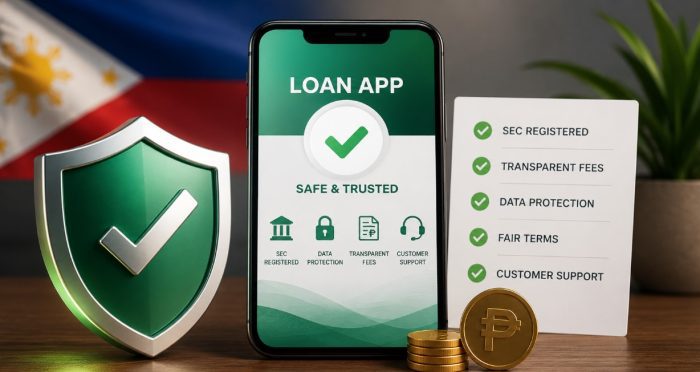
The single most important step is checking SEC registration.
Here is how to do it properly:
Step 1: Go to the official SEC website — sec.gov.ph
Step 2: Click on “Financing and Lending Companies” under the list of registered entities.
Step 3: Search the name of the app or company.
Step 4: Verify that the certificate of authority (CA) is active — not expired, not revoked.
Step 5: Cross-check the app name with the registered company name (they must match or be officially linked).
If the app is not on that list, do not borrow from it.
Period.
The SEC regularly publishes lists of unregistered lending companies and advisory warnings.
As of 2026, there are over 2,400 registered financing and lending companies in the Philippines — but only a fraction of them operate legitimate mobile loan apps.
The rest?
They either operate in a legal gray area or they are outright predatory lenders with no regulatory oversight.
Red Flags That Tell You A Loan App Is Not Safe
Knowing what to look for is just as important as knowing what to verify.
These are the warning signs experienced borrowers and consumer advocates consistently flag:
1. It asks for access to your entire contact list
Legitimate fintech lending apps do not need your contacts to evaluate your creditworthiness.
If an app requires full contact list access as a condition of borrowing, that access will almost certainly be used for harassment during collection.
2. The app is not available on Google Play Store or Apple App Store
Real SEC-registered apps go through app store vetting.
If someone is asking you to download an APK file from a link — do not do it.
3. The interest rate is not clearly disclosed before you sign
Under the Truth in Lending Act (Republic Act 3765), lenders in the Philippines are required to disclose the annual percentage rate (APR) before you agree to a loan.
If the app hides fees in the fine print or shows only a “low daily rate” — that is a red flag.
A “1% daily rate” sounds small.
That translates to 365% per year.
4. It pressures you to decide immediately
Legit lenders give you time to read the terms.
Scam apps use artificial urgency — “This offer expires in 10 minutes!” — because they know if you read carefully, you will walk away.
5. The customer service contact is only a Gmail or Yahoo address
Real lending companies have verifiable business addresses, landline numbers, and official email domains.
If you cannot find any of that — trust your gut.
For a deeper look at how fraudulent platforms operate, this guide on how to spot fake loan apps in the Philippines breaks down the specific tactics used by scammers — including fake SEC registration screenshots that circulate on social media.
The Real Cost Of Borrowing: What Safe Apps Disclose vs. What Unsafe Apps Hide
One of the biggest differences between a trustworthy mobile lending platform and a predatory one is transparency about the total cost of the loan.
| Factor | Safe Loan App | Unsafe Loan App |
|---|---|---|
| SEC Registration | Clearly disclosed, verifiable | Not listed or uses fake CA number |
| Interest Rate | Shown as APR before signing | Hidden in fine print or shown as “daily rate” |
| Processing Fees | Stated upfront | Deducted silently from loan amount |
| Contact List Access | Not required | Required as a condition of approval |
| Collection Practices | Follows BSP debt collection guidelines | Harassment, public shaming via contacts |
| Loan Agreement | Written contract provided | Verbal or click-through only |
| Penalty Fees | Capped and disclosed | Unlimited, applied without notice |
| Customer Support | Verifiable business contact | Only chat bot or unresponsive email |
When you borrow ₱5,000 from an unsafe app, you might receive only ₱3,200 after “processing fees,” “insurance,” and “service charges” — and still owe the full ₱5,000 plus interest by the due date.
That is not a loan.
That is a trap.
SEC-Registered Loan Apps In The Philippines: What The Approval Actually Means
A lot of people assume that “SEC-registered” means the app is perfectly safe.
That is not entirely accurate.
SEC registration means the company has met the minimum legal requirements to operate as a lending company.
It does not mean every registered company operates ethically.
What SEC registration does give you is recourse.
If a registered lender harasses you, charges illegal fees, or violates data privacy — you can file a formal complaint with the SEC and the National Privacy Commission (NPC).
Unregistered lenders have no accountability.
You have no leverage.
That is the real value of SEC registration — not a guarantee of ethics, but the existence of a paper trail and regulatory oversight that protects you.
How To Compare Loan Apps Safely Before You Borrow
Once you have confirmed that an app is SEC-registered, the next step is comparing terms fairly.
Here is a practical approach:
Look at the total repayment amount — not just the interest rate.
If you borrow ₱5,000 for 30 days, ask: How much will I pay back in total?
That number — including fees, interest, and charges — is what matters.
Compare at least 3 apps before deciding.
GCash, Maya, Tonik, CIMB, and several SEC-registered fintech apps now offer personal loan products with transparent terms.
Use the SEC’s published list of registered lenders to filter your options before you start.
Read the loan agreement before clicking “Accept.”
This sounds obvious.
But most borrowers skip it because the text is long and the “Accept” button is big.
The agreement is the only legally binding document you have.
If you do not understand a clause — ask.
If the app has no way for you to ask — that is another red flag.
Check reviews from real Filipino users — with context.
Reviews on Google Play can be helpful, but be aware that some predatory apps flood their listings with fake 5-star reviews.
Look for reviews that mention specific details about fees, customer service response times, and collection practices.
What Happens If You Borrow From An Unsafe App — A Real Scenario
Here is how a typical unsafe app scenario plays out, based on patterns reported to the SEC and Philippine consumer groups:
Day 1: You apply and receive money quickly. The amount is ₱1,000 to ₱2,000 less than what you requested — deducted as “service fees.”
Day 7: A reminder is sent. Friendly tone, no issue.
Day 14: Due date. You cannot pay in full.
Day 15: Calls begin — not just to you, but to contacts saved in your phone.
Day 16-20: Messages are sent to your contacts accusing you of being a swindler (manloloko), sometimes with your photo edited onto memes.
Day 21+: Additional penalties compound daily. The ₱3,000 you borrowed is now a ₱9,000 debt.
This is exactly the cycle that hidden charges in loan apps Philippines exposes — including the specific fee structures that make unsafe apps so profitable for operators and so destructive for borrowers.
Data Privacy: What A Safe Loan App Can And Cannot Access
Under the Data Privacy Act of 2012 (Republic Act 10173), lending companies in the Philippines are prohibited from accessing personal data beyond what is necessary for the loan transaction.
A safe loan app should only request:
- Government ID verification (one valid ID)
- Selfie or liveness check for identity confirmation
- Basic income or employment information
- Bank account or e-wallet details for disbursement
A safe loan app should not require:
- Full access to your contact list
- Access to your SMS inbox
- Permission to read or modify files on your phone
- Social media account login
If an app requests these permissions during sign-up, close it immediately.
File a report with the National Privacy Commission at privacy.gov.ph — they actively investigate data privacy violations by lending companies.
Questions To Ask Before You Borrow From Any Loan App
Before you submit your first application, run through this checklist:
Is this company on the SEC’s list of registered lending companies?
What is the total amount I will repay — not just the interest?
What permissions is this app asking for, and why?
What happens if I cannot pay on time?
How do I contact customer support if there is a problem?
Is there a physical business address I can verify?
Has this app been flagged by the SEC or NPC for violations?
If you cannot answer most of these questions confidently — do not borrow.
Not yet.
Take the time to check.
Your financial safety is worth more than a 5-minute approval.
The Bottom Line On Choosing A Safe Loan App In The Philippines
Choosing a safe loan application in the Philippines comes down to three non-negotiables:
First — confirm SEC registration directly on the SEC website, not through screenshots or the app’s own claims.
Second — read the full cost of the loan before you accept any agreement.
Third — never grant access to your contact list or SMS inbox, regardless of what the app says it needs.
Beyond these three steps, the broader landscape of responsible borrowing in the Philippines is improving.
Regulators are more active.
Consumer complaints are being taken more seriously.
And borrowers who know what to look for are harder to exploit.
The best protection you have is information — and the willingness to walk away from any offer that does not meet the standard.
For more resources on financial literacy and safe borrowing in the Philippines, visit dienbiencflit — a reference point for Filipinos navigating the realities of credit, debt, and digital finance.

Để lại một bình luận